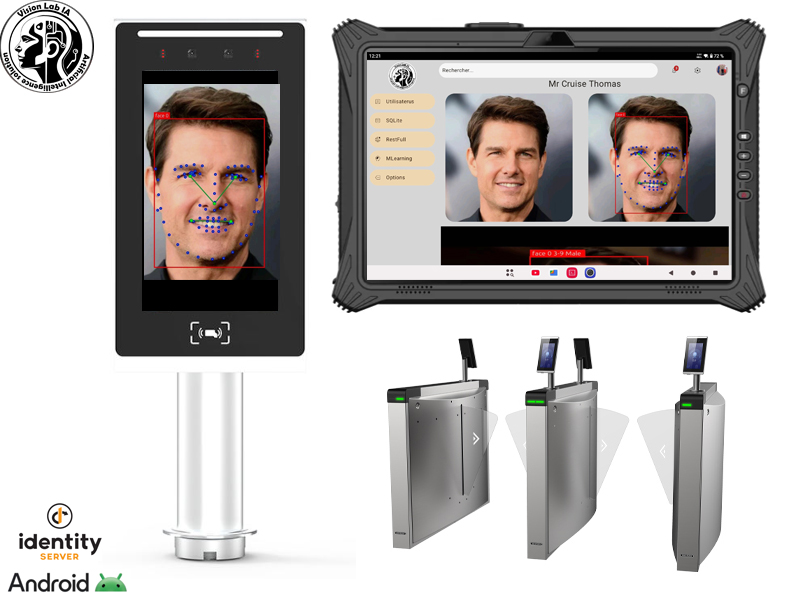

VisionLab-IA-Face-Id
Our AI-powered facial recognition and identification pipeline
guarantees enhanced security and a seamless user experience.
Capable of instantly identifying faces, even in challenging conditions (low light, movement, partial masks),
it integrates easily with your existing systems. Accurate and fast, it's the ideal solution for modernizing your access control,
payment, or customer personalization processes.











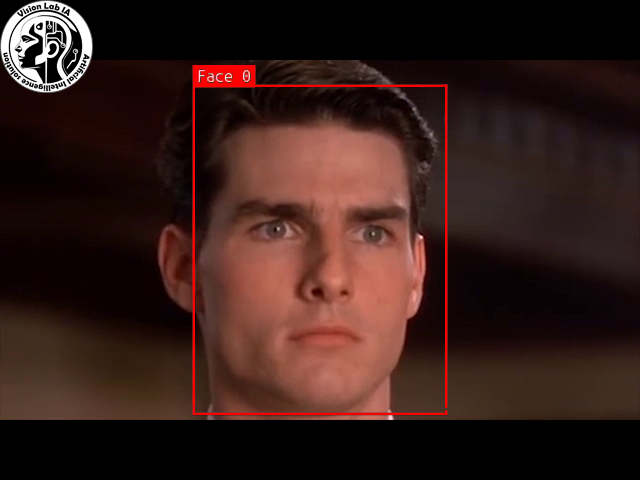
1. Face detection
Our system uses convolutional neural networks (CNNs) optimized for multi-scale detection.
Our AI locates human faces in real time within a video stream, regardless of its size or orientation, and returns a highly accurate face delineation frame.
VisionLab-Face-Id allows you to store the metadata of each detected face for later use.
VisionLab-Face-Id allows you to store the metadata of each detected face for later use.
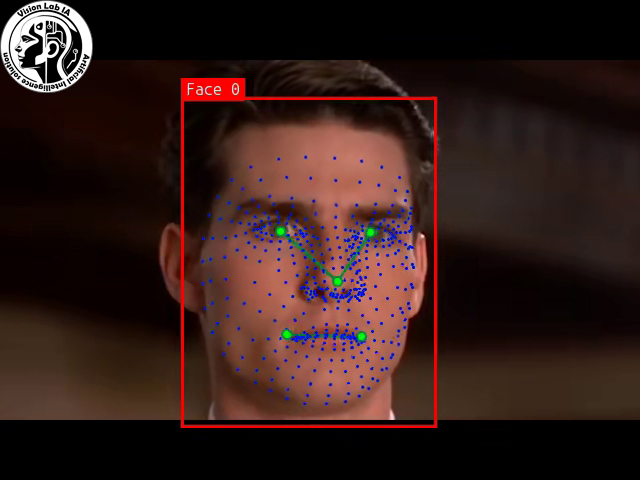
2. Landmarking (reference point extraction)
Our computer vision algorithms, based on deep neural networks,
map dozens of key anatomical landmarks with subpixel precision:
eyes, eyebrows, nose, mouth contours, and facial bone structure.
This three-dimensional geometric analysis, combined with triangulation techniques and the calculation of inter-landmark distances, generates a unique and robust facial signature, even in the event of variations in expression, angle, or lighting conditions.
This three-dimensional geometric analysis, combined with triangulation techniques and the calculation of inter-landmark distances, generates a unique and robust facial signature, even in the event of variations in expression, angle, or lighting conditions.
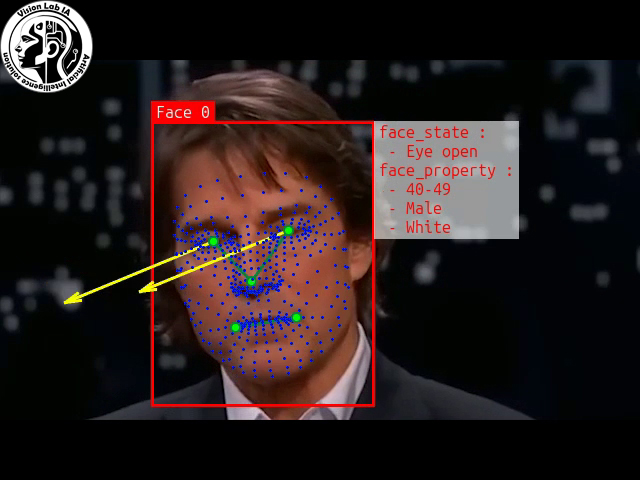
3. Facial Attributes
Our facial analysis engine, powered by multi-task deep learning models, extracts and interprets a wide range of biometric and behavioral attributes in real time:
- Age and sex: estimation based on regressive neural networks trained on diverse demographic databases.
- Head position and orientation: calculation of rotation angles (yaw, pitch, roll) from 3D facial landmarks.
- Eye state and gaze: detection of eyelid opening/closing and gaze direction analysis through pupillary tracking (gaze estimation).
4. Comparison of facial signatures
The extracted anatomical landmarks are converted into a vector facial signature, called an embedding,
using a deep neural network such as Siamese Network or ArcFace.
This vector, typically 128 to 512 dimensions, represents a unique mathematical fingerprint of the face,
invariant to variations in pose, lighting, or expression.
The AI then performs a comparison by calculating the cosine or Euclidean distance between this vector and those stored in your database. Thanks to optimized indexing (ANN - Approximate Nearest Neighbors) and GPU parallelization, this operation is performed in milliseconds, even on databases of several million individuals.
The system then delivers an authentication decision with an adjustable tolerance threshold, ensuring a balance between recognition rate and false acceptance rate.
The AI then performs a comparison by calculating the cosine or Euclidean distance between this vector and those stored in your database. Thanks to optimized indexing (ANN - Approximate Nearest Neighbors) and GPU parallelization, this operation is performed in milliseconds, even on databases of several million individuals.
The system then delivers an authentication decision with an adjustable tolerance threshold, ensuring a balance between recognition rate and false acceptance rate.
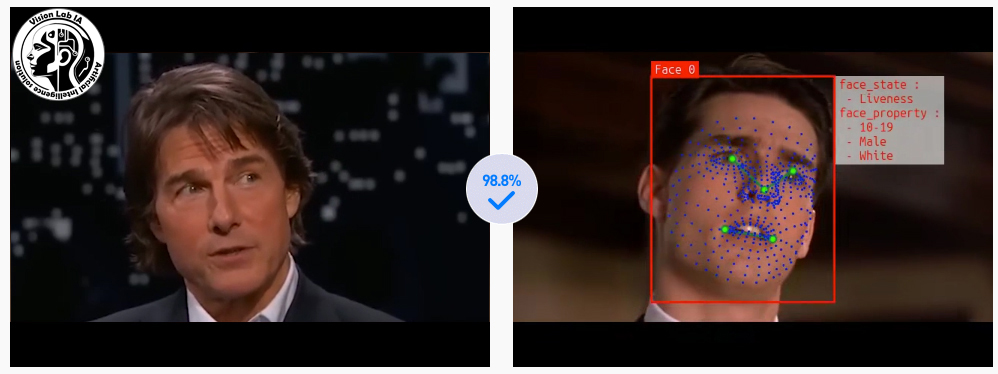
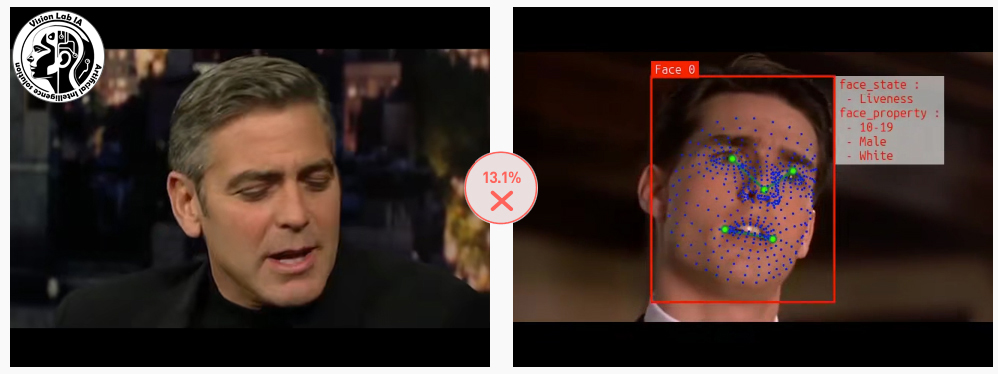
Comparing facial signatures
Facial signature comparison is a powerful technology that offers numerous security and convenience benefits. However, it is important to use it responsibly and consider the ethical implications of its use.
1. Facial image capture:
An image or video of the person's face is captured using a camera.
2. Face detection:
AI identifies the presence of a face in the image and locates its main features, such as the eyes, nose and mouth.
3. Extraction of facial features:
AI analyzes facial features and extracts key points, called facial landmarks. These points represent the geometric structure of the face, such as the distance between the eyes, the shape of the jaw, and the position of the nose.
4. Creation of the vector facial signature:
The facial landmarks are then converted into a digital representation called a vector facial signature. This signature is a unique mathematical fingerprint that represents the person's face.
5. Comparison of facial signatures:
The AI compares the generated vector facial signature to a database of pre-existing facial signatures. This database contains the facial signatures of individuals authorized to access the system.
6. Access validation:
The AI calculates the degree of similarity between the captured facial signature and the facial signatures in the database. If the similarity exceeds a certain threshold, the AI grants access to the person.
Advantages of Facial Signature Comparison:
- Enhanced Security: Facial signature comparison is a robust biometric authentication method that is difficult to forge.
- Ease of Use: Facial authentication is a convenient and intuitive method that does not require memorizing passwords or PINs.
- Speed: AI can compare facial signatures in a fraction of a second, enabling rapid access validation.
Applications of Facial Signature Comparison:
- Physical Access Control: Validating access to buildings, offices, and areas secure.
- Digital authentication: Access to mobile devices, online accounts, and banking applications.
- Surveillance and security: Identification of wanted persons or suspects in public places.
VisionLab-IA-IoT - Android Totem
Offer your users the perfect blend of speed and security: the Android facial recognition totem, backed by the robustness of Microsoft Identity Server.
Instant unlocking, a seamless experience, and centralized authentication worthy of the largest enterprises.
A simple-to-integrate solution that combines the best of mobile biometrics and Microsoft's identity infrastructure.
Because in a connected world, trust is built on solid foundations.
Adopt it, and make identification a true strategic asset for your brand.